In today’s cybersecurity landscape, insurance companies face complex challenges in protecting their information systems and their customers’ sensitive data. This interview explores the specific cybersecurity challenges facing the insurance industry, including web application protection, threat management, and the need to ensure service continuity. It highlights the importance of adopting robust and tailored security solutions, such as Web Application Firewalls (WAFs), to mitigate risks and strengthen organizations’ security posture.
Through an interview with Laurent Gaschaud, IT Security Manager, and Vincent Vally, IT Security Lead at Thélem Assurances, this article also addresses the key criteria to consider when choosing a WAF solution, such as the one offered by OGO Security, emphasizing the importance of performance, reliability, ease of use, and the quality of technical support.
What are the main cybersecurity challenges you face as an insurance company, and how do you go about protecting your sites and data?
“We must constantly ensure that our information systems are resilient against internal and external threats. This involves close monitoring of vulnerabilities, regular incident response and cyberattack drills, and continuously strengthening our protection against data breaches. A particular challenge concerns the security of our cloud systems, whether they are IaaS platforms like Azure or other forms of cloud deployment. It is important for us to apply the same security standards as we do for our traditional data center infrastructure. The rise of artificial intelligence also presents a new challenge, raising complex questions about data storage and flow.
For an insurance company, the priority is to ensure service continuity. Our business relies on the efficient processing of claims, as well as the sale and management of policies. The 24/7 availability of our information systems is therefore essential to serving our customers.”
Securing information systems requires a multidimensional approach, including rigorous monitoring of vulnerabilities, incident and cyberattack response exercises, and enhanced protection against data exfiltration. Complexity increases with cloud deployments (IaaS, PaaS, etc.), where applying security standards equivalent to those of on-premises infrastructures is essential. The integration of artificial intelligence introduces new risk vectors related to data governance and location. Monitoring the Dark Web and Deep Web is also essential for the early detection of potential data leaks. All of these requirements stem from the critical nature of insurance companies’ information assets, which are prime targets for cyberattacks.
This is especially true in this type of industry, where service continuity is paramount. Business operations – centered on underwriting policies and processing claims – depend on the uninterrupted availability of information systems. Therefore, 24/7 operation is essential to ensuring customer service and meeting contractual obligations. The operational and financial consequences of an outage – whether resulting from a cyberattack or a system failure -underscore the need for robust cybersecurity.
Why did you choose to partner with OGO Security for your web security project?
“In early 2023, we were looking for a solution to protect our websites exposed to the Internet. We also wanted additional security beyond simply patching our Internet-exposed assets. Furthermore, we were experiencing performance issues and lacked adequate protection against denial-of-service attacks.
After evaluating several products, we chose OGO Security because this sovereign solution seemed easy to deploy and well-suited to our application portfolio – especially since, when we tested it, it demonstrated true speed and efficiency in implementation. Financial and contractual considerations also played a role; in particular, transparency regarding future pricing changes was a decisive factor. We prioritize long-term partnerships and cost predictability.”
The need for a solution to secure websites exposed on the Internet is fundamental. Performance issues, such as latency, and inadequate protection against distributed denial-of-service (DDoS) attacks are aggravating factors. A Web Application Firewall (WAF) is a technical solution well-suited to these challenges. A WAF operates at the application layer (Layer 7 of the OSI model), analyzing HTTP/HTTPS traffic to detect and block malicious requests targeting vulnerabilities in web applications. Common attacks that WAFs can mitigate include SQL injections, cross-site scripting (XSS), and application-layer attacks.
A rigorous evaluation of security solutions – and WAFs in particular – is an essential step before implementing them. Conducting tests, often referred to by the acronym POC (Proof of Concept), helps validate whether the solution meets the specific needs of the application environment. These tests must cover several aspects, such as the effectiveness of attack detection and blocking, the impact on application performance, ease of deployment and configuration, and integration with the existing infrastructure. In the context of insurance companies, where the availability and integrity of web services are major concerns, a thorough evaluation under real-world conditions is essential to minimize the risks associated with implementing a new security solution.
The criteria for selecting a WAF solution are not limited to technical features alone. Financial and contractual aspects are also of significant importance. Vendor transparency regarding pricing policies- particularly future changes- is a key factor in long-term investment decisions. The ability to establish lasting partnerships, based on trust and cost predictability, is a key consideration when choosing a security solutions provider.
Can you describe the benefits and results observed following the implementation of the OGO solution?
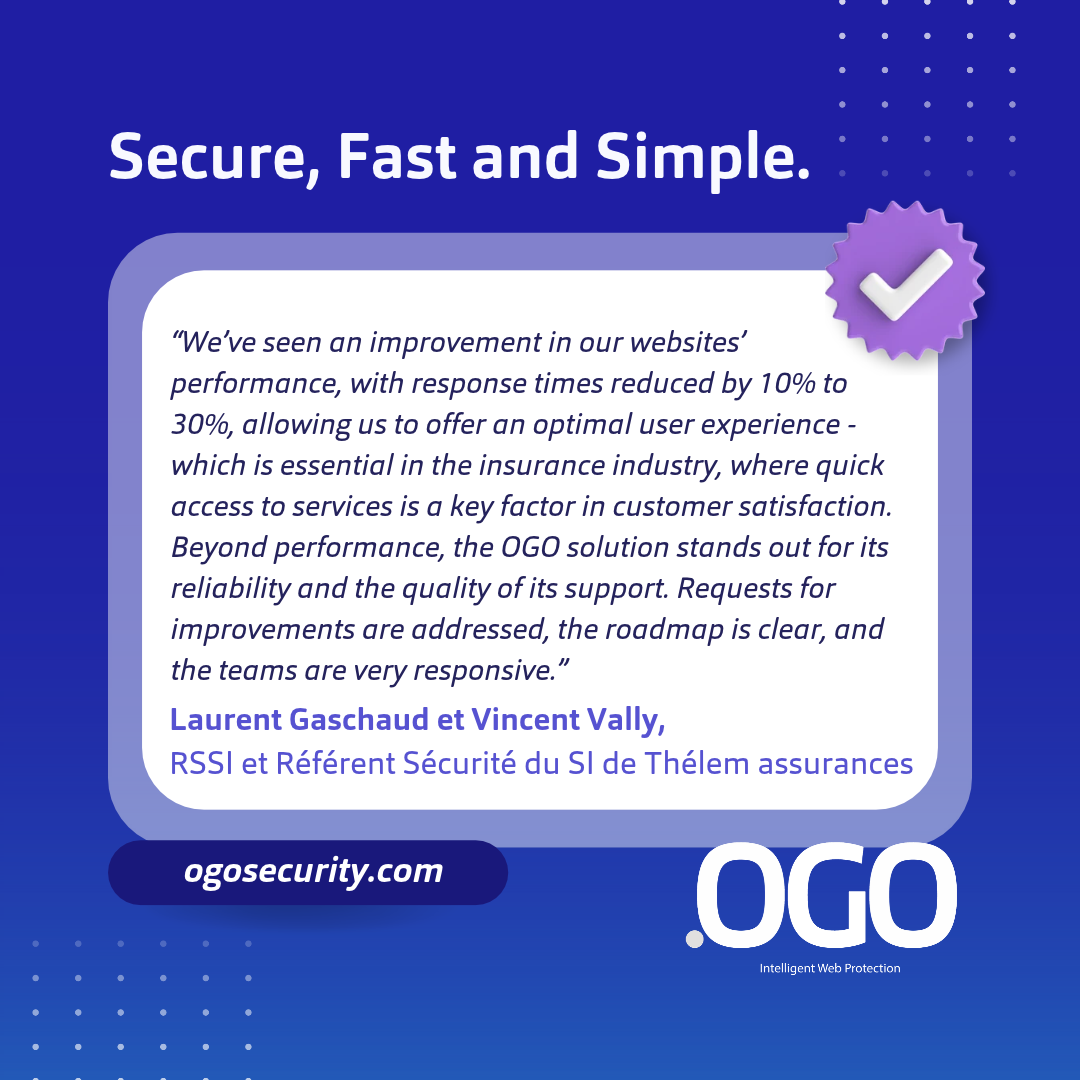
“We’ve seen an improvement in our websites’ performance, with response times reduced by 10% to 30%, allowing us to offer an optimal user experience – which is essential in the insurance industry, where quick access to services is a key factor in customer satisfaction.
Beyond performance, the OGO solution stands out for its reliability and the quality of its support. Requests for improvements are addressed, the roadmap is clear, and the teams are very responsive.
In addition, the solution generates precise alerts in the event of suspicious activity, enabling our security teams to respond quickly. We have great confidence in the solution, which allows us to focus on other aspects of our information system’s security.”
Implementing a WAF often results in a noticeable improvement in website performance, with significant reductions in response times (up to 30% in some cases). This optimization directly contributes to an enhanced user experience, a key factor in the insurance industry, where the speed of access to online services has a major impact on customer satisfaction. WAFs can achieve these performance gains by caching static content, compressing data, and optimizing traffic flow between users and application servers.
In addition to performance benefits, a mature WAF solution offers high reliability and comes with responsive, knowledgeable technical support. The consideration of requests for enhancements, a clear product roadmap, and highly responsive support teams are indicators of the quality of the service provided. These elements are essential to ensuring optimal use of the solution and continuous adaptation to the company’s needs.
A high-performance WAF is also capable of generating accurate and actionable alerts when suspicious activity is detected, which facilitates a rapid and effective response from security teams. This detection and alerting capability builds confidence in the solution and frees up internal resources to focus on other aspects of information system security. In this sense, a WAF solution becomes a stable and high-performing component of the security infrastructure, contributing to a stronger security posture.
Which aspects of the OGO solution and the support provided to teams do you find most beneficial?
“Compared to other WAFs, OGO’s interface is intuitive and easy to use. The solution is stable, high-performing, and ensures uninterrupted service. Furthermore, OGO Security’s management of SSL certificates ensures service continuity for our customers, even in the event of internal issues.
Another strength is the responsiveness of the technical support team. Our requests for improvements are taken into account, and communication is seamless. The speed with which vulnerabilities are addressed is essential. For example, when a new Apache vulnerability was discovered, the OGO Security teams quickly deployed a virtual patch. This responsiveness is a major asset for both them and us.
OGO Security’s transparency regarding its strategy and long-term sustainability is also very important to us. In a market where acquisitions are frequent, it’s important to work with a reliable, long-term partner.”
The usability and ease of use of a WAF solution are key factors in its adoption and operational effectiveness. An intuitive interface reduces the complexity of application security management, thereby shortening the learning curve and simplifying administrative tasks. The stability and performance of the solution are also essential for ensuring continuous protection without service interruptions. In fact, the WAF provider’s integrated management of SSL certificates simplifies operations and enhances service continuity for web applications, even in the event of internal incidents.
Similarly, the quality of technical support and customer service is a key factor in choosing a WAF solution. Responsive support, consideration of requests for improvements, and smooth communication are indicators of a strong partnership and a commitment to customer satisfaction. The speed of response to security vulnerabilities is particularly important in today’s environment of dynamic cyber threats. Thus, the provider’s ability to quickly deploy virtual patches to mitigate new vulnerabilities is a major asset in maintaining a high level of security.
Finally, other factors—such as the transparency and long-term sustainability of the WAF solution provider—build trust with customers. In a market where mergers and acquisitions are common, the provider’s stability and long-term vision are key factors in the decision to establish a lasting partnership. The provider’s ability to clearly communicate its strategy, financial health, and growth prospects strengthens the customer’s confidence and reassures them regarding service continuity and the solution’s future development.
If you had to summarize your experience with OGO Security, what would you say?
“Trust, efficiency, simplicity”